
Global equities rebounded in the second quarter as confidence in the AI investment cycle strengthened. As the third quarter begins, we believe markets have become priced for a smooth and profitable AI build-out, leaving little margin for error. June’s sharp sell-off in the Magnificent Seven stocks underscored how quickly sentiment can shift when crowded AI trades are priced for near-flawless execution.
It didn’t take long for equity investors to brush off the Iran-war oil shock of the first quarter. The MSCI ACWI Index of global stocks surged by 14.9% in US-dollar terms in the second quarter (Display), erasing losses earlier in the year to post an 11.2% first-half gain. Emerging markets and US small-caps outperformed. US large-caps ended the quarter slightly ahead of the global benchmark while European stocks posted solid gains but underperformed.
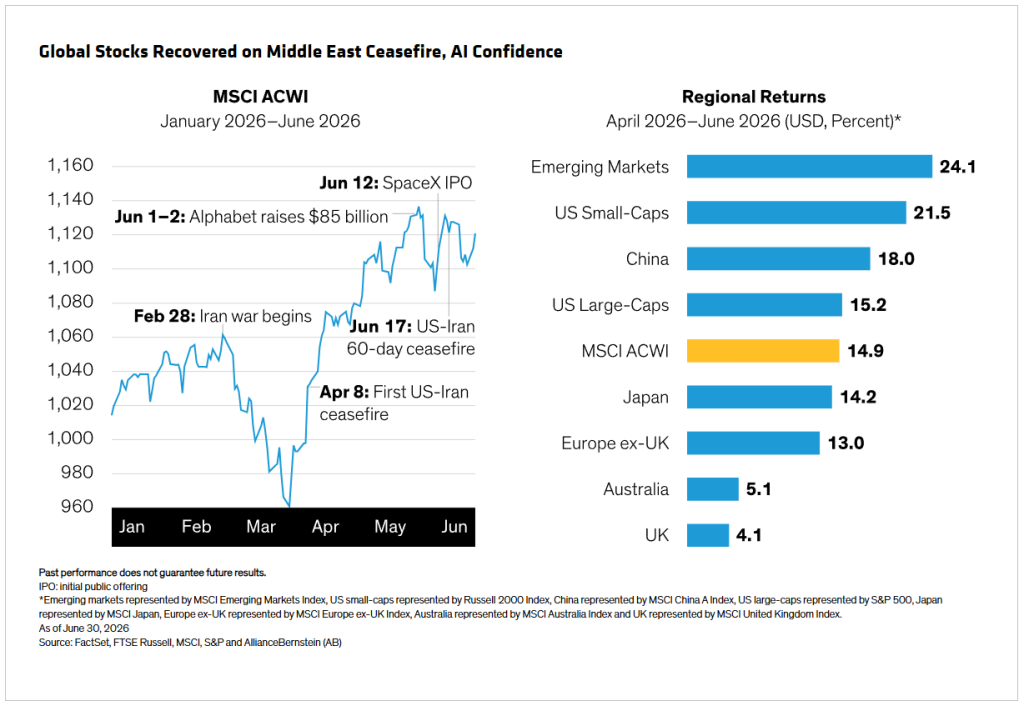
The recovery, however, was uneven. Stocks weakened in June after rising through May, and volatility increased toward quarter-end. We believe the erratic pattern reflects a two-speed equity market, as markets struggle to balance conflicting sentiment between macroeconomic caution and AI conviction.
Energy was the worst-performing sector, reversing first-quarter gains as oil prices fell sharply on hopes that a US-Iran deal would open the Strait of Hormuz and unlock the energy-supply bottleneck (Display). Technology returns outpaced the market, even after the sector gave back gains in June, when a sharp Magnificent Seven sell-off reinforced our conviction in portfolios with broader market exposure. Style trends also reflected changing sentiment. Global growth stocks outperformed in the second quarter, but value stocks remained ahead for the first half. During most of the quarter, market volatility was relatively low, yet dispersion beneath the surface was elevated, indicating ongoing uncertainty.
AI Build-Out: Will Capex Create Profits?
AI enthusiasm drove the market for most of the second quarter and is lifting long-term macroeconomic growth expectations. Yet the build-out is also raising concerns. For investors, the fundamental question is: Will massive capital spending (capex) ultimately generate attractive returns?
Mounting competition has prompted the US hyperscalers to put their full financial muscle behind efforts to secure advantages. The five biggest spenders—Amazon, Microsoft, Alphabet (Google’s parent), Meta Platforms and Oracle- are on pace to pump $1.0 trillion into AI-related investments in 2027, according to our research. That’s a 33% increase in estimated spending for 2026, up from $96 billion just five years ago.
In our view, market expectations already reflect new spending levels across technology industries. Yet we believe growth rates matter more for share valuations than absolute capex levels. Capex growth rates are poised to peak this year (Display). As spending growth decelerates, investors may focus more on whether earnings and cash flows can meet expectations.
Cash flows are under pressure. Free-cash-flow (FCF) generation for the hyperscalers is poised to turn negative next year for the first time, according to our forecasts. Even fast-growing AI revenues will take time to offset the scale of investment. These trends could eventually erode profitability and challenge valuations. How each company manages these dynamics will determine whether they succeed or fail in translating the promise of AI into returns for investors.
Record IPOs: Funding the Next Phase
Investors are also scrutinising a wave of AI-related initial public offerings (IPOs). Here, too, the key issue is whether future earnings justify expectations.
Anthropic and OpenAI, two leading AI technology firms, are expected to go public later this year and have no profits. Demand for these IPOs will indicate investors’ appetite for funding the next phase of the AI story.
Two large share offerings in the second quarter showcased market sentiment. In early June, Alphabet (Google’s parent) raised $85 billion in a share offering partially backed by Berkshire Hathaway. As AI funding shifts to public markets, we believe financing discipline—and a credible story for investors—will matter as much as technology prowess.
In mid-June, Elon Musk’s SpaceX raised $75 billion in a record IPO, after which the company’s market capitalisation peaked at $2.6 trillion. The deal showed that investors are still willing to pay premium prices for transformational technology potential, even without tangible profits. But post-IPO trading volatility was a reminder of how quickly sentiment can shift.